




Our Mathematical World
Project Overview
Our Mathematical World brings mathematics to life for 3rd through 5th graders through rich stories, engaging community connections, and a metacognitive approach to problem solving. The project supports students to see themselves as strong mathematical problem solvers, while developing executive function skills (EFs) and multi-step problem solving abilities through the mathematics they encounter in their everyday lives.
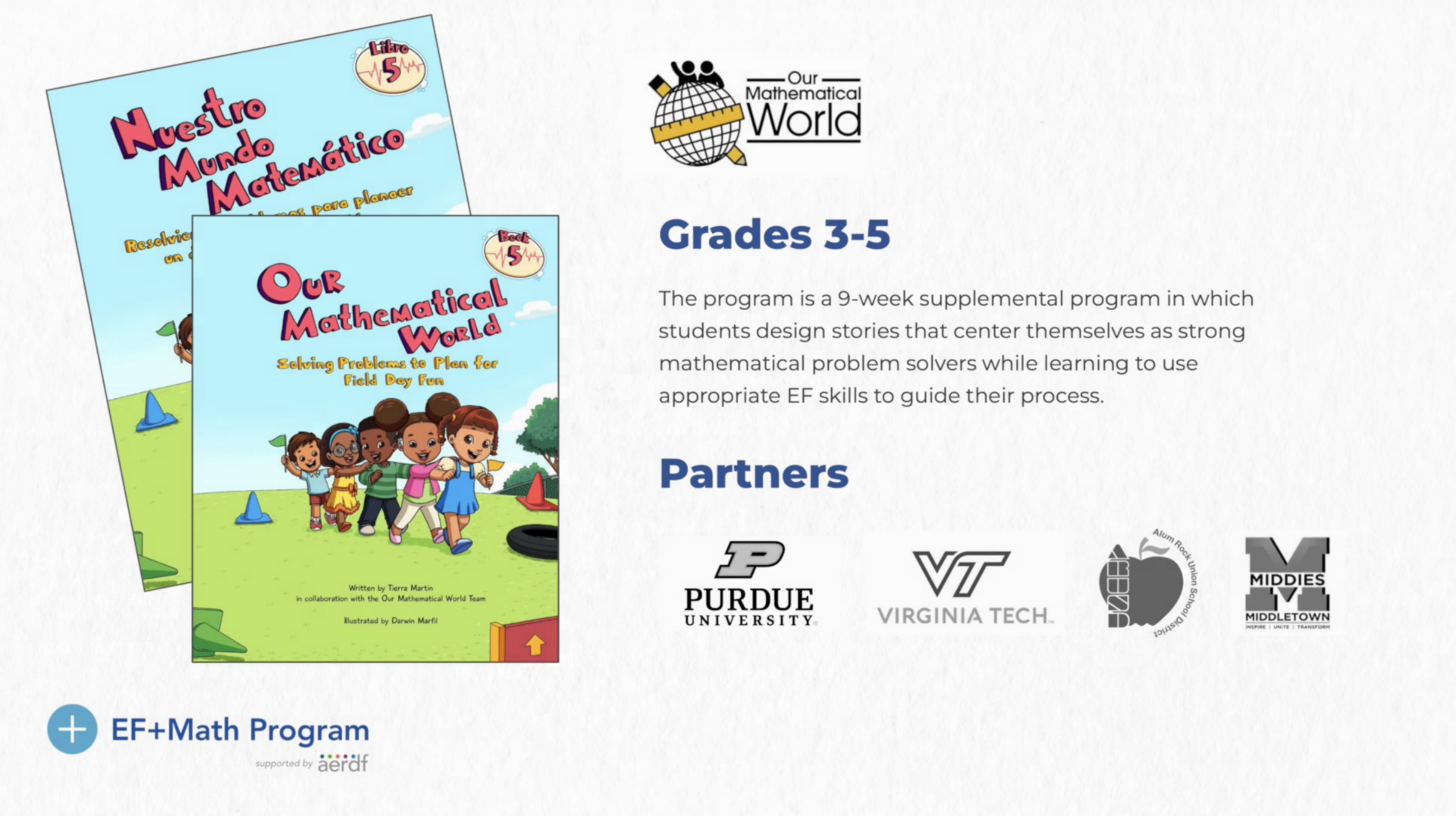
Our Mathematical World is a nine-week supplemental program designed to work within students’ regular math instruction. Students engage with co-designed storybooks featuring diverse characters who model the PULSE approach for problem solving (Pause, Understand and Remember, Lay it Out, Solve, Evaluate). Students also explore their own communities through a mathematical lens, learn about real-world “math heroes” from their communities, and create stories that center themselves as confident mathematical thinkers. Our Mathematical World is available in English and in Spanish.
Project Approach
Our Mathematical World’s approach weaves together math, executive function skills (EFs), and equity to help students improve their problem solving skills through materials that reflect diverse student interests, backgrounds, and experiences.

Mathematics
A supplemental program designed to develop multi-step problem-solving and procedural skills for students in grades 3-5.

Executive Function Skills
Integration of EF and metacognitive skill development through short EF games and the PULSE approach for problem solving (Pause, Understand and Remember, Lay it Out, Solve, Evaluate).

Equitable Learning Experiences
Building students’ math identity and strengthening students’ connections between math and their communities through storybooks, math hero biographies, and lessons on math identity.
Project Impact
Our Mathematical World has produced measurable impact in classrooms, reaching hundreds of students and educators, while contributing research findings to advance math education.

Key Insights and Innovations
PULSE approach helps students strengthen executive function skills and problem solving
The program introduces students to the PULSE approach—Pause, Understand and Remember, Lay it Out, Solve, and Evaluate—a metacognitive approach that integrates EFs and problem solving skills into a memorable, transferable process. By applying PULSE to classroom and real-world math challenges, students learn to plan, reflect, and monitor their own thinking—skills that strengthen both their EFs and mathematical reasoning.
Storybooks co-designed with students bring mathematics to life
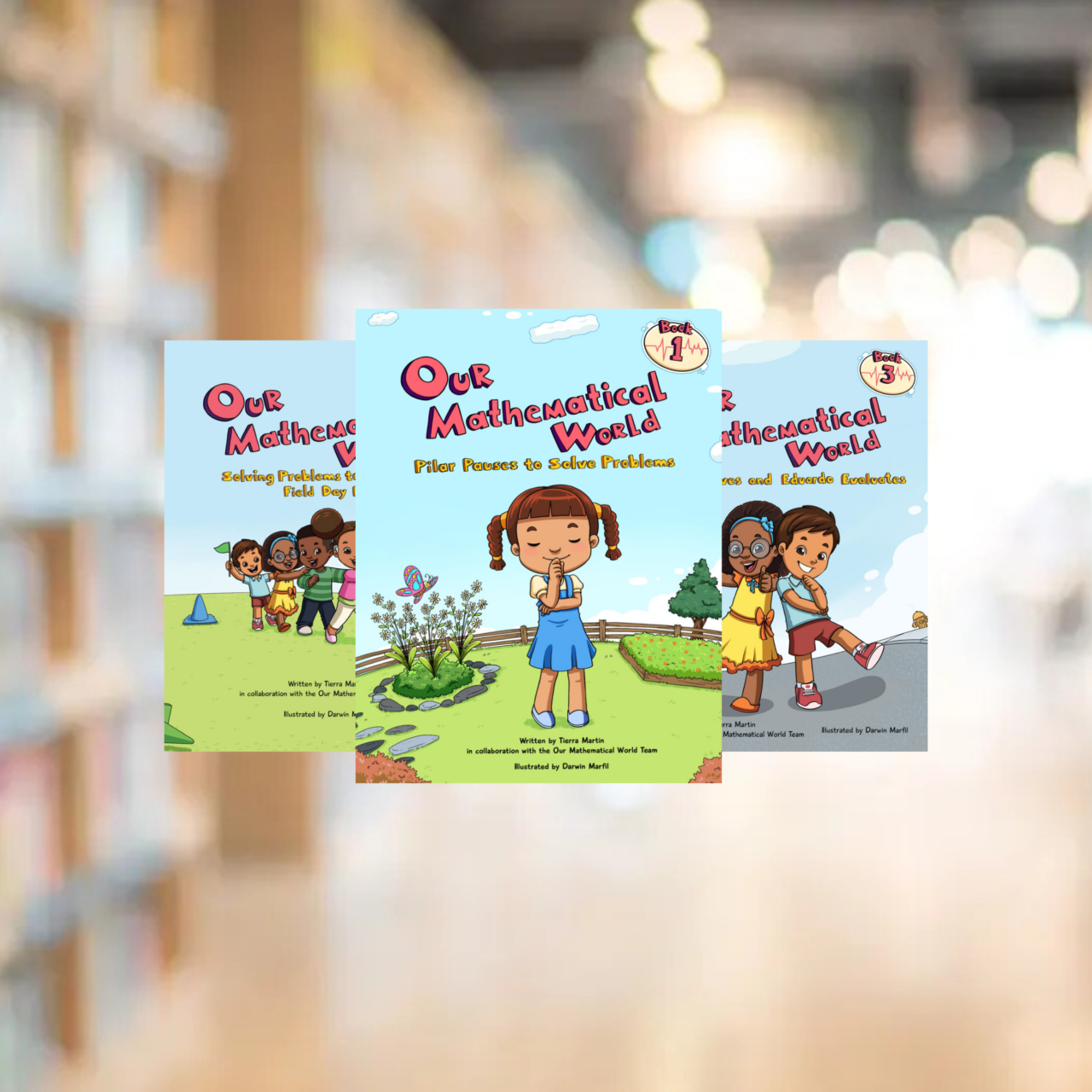
The PULSE approach is brought to life through an original five-book series co-designed by educators, students, and researchers as part of the Our Mathematical World project. Throughout the series, a set of student-designed characters (Pilar, Uriah, Lamar, Simone, and Eduardo) introduce the PULSE approach and use it to solve math problems in their community. Students contributed drawings, ideas, and feedback that directly shaped the stories and illustrations, ensuring an authentic representation of their voices and experiences. This unique approach helps students engage with the PULSE process and see themselves as capable problem solvers, and it centers diverse perspectives in mathematics learning.
Building students’ math identities through a focus on community, belonging, and representation
Our Mathematical World invites students to explore mathematics in their own communities through activities like a “math walk” and to experience examples of people who use math in their careers through biographies of Black and Latine “math heroes.” These experiences help students recognize math in their everyday lives and see people who look like them succeeding in mathematical fields, fostering a sense of belonging in math and a positive math identity.
Executive function skill development integrated throughout the program and storybooks
Our Mathematical World integrates EF skill development throughout the supplemental program. Weekly lessons introduce students to core EF skills—working memory, inhibitory control, and cognitive flexibility—using concrete, relatable examples, such as a person directing traffic. Lessons intentionally teach these skills and provide opportunities for students to practice them through offline games, such as Slap Jack or the Freeze Game. EF skills are woven consistently throughout the program. EF terminology is reinforced in the PULSE problem-solving approach used in lessons, and in the five storybooks, helping students connect these skills to real-world problem solving and everyday learning.
Research Highlights
Acknowledgments
Special thanks to the administrators, teachers, and students from the participating schools, as well as our collaborative partners from the EF+Math Program Advisory Board. The full list of our Collaborative Partners is listed on the Our Mathematical World website.
We gratefully acknowledge the leadership of Purdue University and Virginia Tech, with collaboration from New York University, the University of Delaware, Kent State University, the University of Texas at Austin, the University of Pittsburgh, Santa Clara County Office of Education, Western University, Louisiana State University, and Enuma, Inc.
Explore Our R&D Projects
The EF+Math portfolio of R&D projects developed innovative math learning products and advanced research on mathematics learning, executive function, and equitable learning experiences using inclusive R&D methods.