





Spark Math
Project Overview
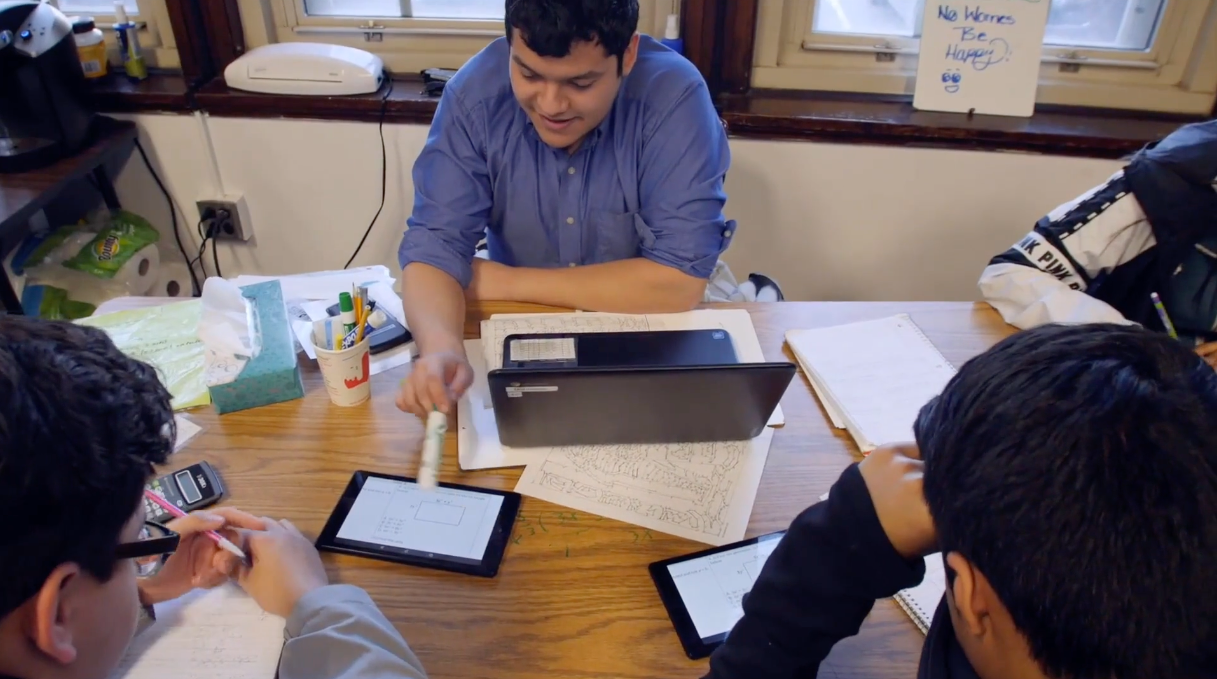
Spark Math is a bold reimagining of the classroom, with units designed to actively engage students in authentic mathematical problem solving, with executive function and metacognitive supports embedded into belonging-centered instruction. Simulations and project-based learning activities provide opportunities for students to engage in mathematical discourse and shared exploration of math.
Spark Math strengthens students’ mathematical understanding and executive function skills (EFs) through four modular replacement units for students in grade 6. The units focus on building students’ conceptual understanding of mathematics through engaging lessons and learning games, professional learning that helps teachers develop their ability to engage in culturally relevant instruction and support students’ EFs, and opportunities for online adaptive practice. Through hands-on lessons and Skye, an immersive virtual world, students explore math in ways that connect to their experiences and communities. In Skye, learners travel across virtual islands to complete EF and math challenges, engage in simulations, and watch short videos that highlight diverse mathematicians.
Each unit integrates games that blend EF skill practice with math conceptual development and supports for planning, persistence, and reflection, helping students recognize and strengthen the EFs that enable them to succeed in math and beyond.
Project Approach
Spark Math’s approach weaves together math, EFs, and equity to help students develop their understanding of key middle school concepts and confidence as mathematical thinkers.

Mathematics
Belonging-centered instruction focused on the critical topics of ratios, expressions & equations, and statistics for students in grade 6.

Executive Function Skills
Students actively engage in opportunities to strengthen their metacognition and EF skills within a coherent instructional subsystem that weaves together EF supports in authentic mathematical problem solving and activities to build teacher and student learning and awareness of EF skills.

Equitable Learning Experiences
A learning environment that centers students’ cultural and intellectual assets and creates instructional opportunities for fostering a sense of belonging in the classroom.
Project Impact
Spark Math has produced measurable impact in classrooms, reaching thousands of students and educators, while contributing research findings to advance math education.

Key Insights and Innovations
Modular units provide flexible curriculum that adapts to classroom needs
Spark Math is organized as four flexible replacement units—Community Building & Executive Function Skills, Making Sense of Ratios, Expressions & Equations, and Statistics—that can be implemented independently or as a complete sequence. The program provides comprehensive materials, including print and digital workbooks, teacher guides, slide decks, dashboards, and both analog and digital EF skill building games. This modular design allows educators to adapt resources to their specific classroom contexts while supporting deep mathematical understanding across key sixth grade topics.
Adaptive virtual world connects math and executive function skill practice through game-based exploration
Spark Math’s Skye Adaptive Practice Virtual World reimagines math practice as an immersive learning experience. Students navigate themed islands within each unit, completing math and EF skill challenges to earn coins and planks that build bridges to new content. The environment blends adaptive asset-based EF skill activities, PhET simulations, and “Cinema” videos showcasing diverse mathematicians, creating a structure for independent and collaborative learning that motivates students, supports transfer of EFs to math problem solving, and provides a responsive environment for students to receive feedback.
Community building unit establishes foundation for math identity and executive function skill development
Spark Math opens with a Community Building unit designed to create a strong classroom culture before diving into math content. Students and teachers explore identity, interests, and belonging while developing a shared understanding of growth mindset and mathematical mindset. Through games and activities, students are explicitly introduced to EFs—working memory, inhibition, and cognitive flexibility—and learn how these skills support both learning and collaboration. By connecting EFs to math, games, and students’ own worlds from the start, the unit positions all students as capable math learners.
Asset-based approach to executive function skill development positions executive function skills as tools that give students agency over their own learning
Spark Math explicitly teaches students about working memory, inhibition, and cognitive flexibility through accessible lessons, then provides ongoing practice through games like Equivacards (a unique take on the Uno card game), Set, and Rat-a-Tat Cat that integrate multiple EF skill demands with math content. This explicit-then-embedded approach intentionally weaves game play throughout the curriculum to help students practice EFs and strategic thinking while building relationships with peers. By framing game play as both skill-building and collaborative fun, Spark Math creates opportunities for students to strengthen the cognitive abilities they need for complex math while fostering classroom community.
Research Highlights
Overemphasizing Individual Differences and Overlooking Systemic Factors Reinforces Educational Inequality
Making Math Fun: Developing Executive Function Strategies and Math-Positivity through Gameplay
Acknowledgments
We gratefully acknowledge the leadership of Saga Education, in partnership with sub-award recipients at the University of California, Davis; the University of Colorado Boulder; the University of Michigan; and Virginia Tech, and with collaboration from Blackhawk Technical College, Lehigh University, and Silvis Materials.
Explore Our R&D Projects
The EF+Math portfolio of R&D projects developed innovative math learning products and advanced research on mathematics learning, executive function skills, and equitable learning experiences using inclusive R&D methods.