





Pennesota
Project Overview
The Pennesota project developed scalable and equitable detectors for constructs related to executive function skills (EFs) during math learning. By capturing real-time insights into how students engage with mathematics—including attention, strategy use, and learning behaviors—the Pennesota technology enables personalized, just-in-time supports that help all students succeed.
Understanding what’s happening in students’ minds as they tackle complex math problems has traditionally been difficult to measure at scale. The Pennesota project addresses this challenge by developing technology to detect behaviors like mind wandering, strategy invention and application, and the quality of peer feedback. This novel technology is designed to be integrated into any technology-based product or math learning system, enabling it to capture in-the-moment data on students’ EFs without disrupting their learning.
As part of the EF+Math Program, the Pennesota and CueThinkEF+ projects collaborated to embed detectors and probes directly into the CueThinkEF+ learning platform, providing teachers with actionable insights and enabling adaptive supports tailored to individual student needs. This collaboration demonstrates the feasibility of integrating the Pennesota technologies into an existing edtech platform and paves the way for future applications of the technology.
To learn more and get in touch, explore the work of project leaders Caitlin Mills, Stephen Hutt and Ryan Baker.
University of Minnesota
Project Approach
Pennesota’s approach combines innovative measurement, adaptive learning supports, and equitable design to make students’ thinking visible in real time and provide just-in-time feedback that helps all learners thrive in mathematics.

Innovative Measurement
New ways to capture student learning, including real-time thought probes and scalable webcam-based eye tracking.

Adaptive Tools
Real-time supports for both students and teachers. The system helps students try new strategies, improve their peer feedback, and guides teachers in supporting problem solving in their classrooms.

Designed for All Learners
Designed and tested in partnership with schools serving Black, Latino, and low-income students, these tools were also rigorously checked for algorithmic bias, ensuring their potential to make math learning more engaging and effective for all learners.
Project Impact
The Pennesota project’s novel, co-designed technologies are enhancing learning products, while advancing how we measure, understand, and support students’ thinking in real time.

Key Insights and Innovations
Embedded detectors can recognize when students are engaged in self-regulated learning
Pennesota developed automated detectors that identify how students regulate their learning during mathematical problem-solving. The detectors, which can be fully integrated into the backend of an edtech tool, draw on usage data that captures students’ actions on the platform and can recognize when students engage in productive behaviors such as representing problems accurately, transforming information strategically, and following through on their plans.
Within the EF+Math Program, the detectors were applied to the CueThinkEF+ platform to understand how students engaged in self-regulated learning (SRL) behaviors, such as transforming data and following plans, during problem solving, and to identify when students invented new strategies for solving problems. This approach represents a significant advance over traditional SRL assessment methods because it demonstrated the feasibility of designing data collection in direct alignment with theoretical models, and showed how this could be scaled and operationalized across an edtech platform.
In-the-moment probes capture real-time student thinking during problem-solving
The Pennesota team developed embedded thought probes that gather real-time, student-reported data about engagement, mind wandering, self-efficacy, and strategy use as students work through math problems on an online platform. The probes were co-designed with students and equity advisors to ensure that their messaging and presentation were supportive and affirming. These probes served as the basis for “in-the-moment measures” that provided actionable information about learning states that are critical but difficult to see, such as when a student feels stuck, loses focus, or decides to change their approach. These probes were embedded into the CueThinkEF+ learning system and have also been applied to other edtech learning systems.
Automated scoring of responses to complex, open-ended math problems that attends to students’ reasoning and approach
The Pennesota team developed an automated accuracy detector that evaluates student responses to complex, open-ended mathematics problems, moving beyond binary right/wrong scoring to interpret correctness with nuance—including partial credit based on reasoning and problem-solving approach. Unlike traditional grading tools that rely on fixed-answer models, this detector uses AI to recognize multiple plausible solutions and analyze student work for context, making it responsive to the diverse and authentic ways students demonstrate mathematical thinking. This technology was developed and tested within CueThinkEF+’s Thinklet videos but is designed to be adaptable for open-ended math tasks across different learning platforms
AI-based detectors can provide real-time guidance to support high-quality peer feedback
Pennesota AI-based detectors assess the quality of students’ feedback on peers’ mathematical problem-solving and provide real-time guidance for improvement. By helping students strengthen their comments, the system supports peer learning experiences that are substantive and constructive, developing students’ skills as collaborators and mathematical communicators.
Mind wandering can be detected faster, more accurately, and more affordably with webcam-based technology
The Pennesota team demonstrated that mind wandering and reading comprehension can be accurately predicted in real-time using an open source webcam-based eye tracker. The webcam-based eye tracking method is a privacy-forward technology that doesn’t store video and is faster, more affordable, and more scalable than the expensive commercial-grade equipment that is traditionally used in eye gaze research. The Pennesota team tested it for bias and verified that it works reliably across diverse conditions. This approach opens new possibilities for understanding student attention in real classroom and online learning environments in a non disruptive way.
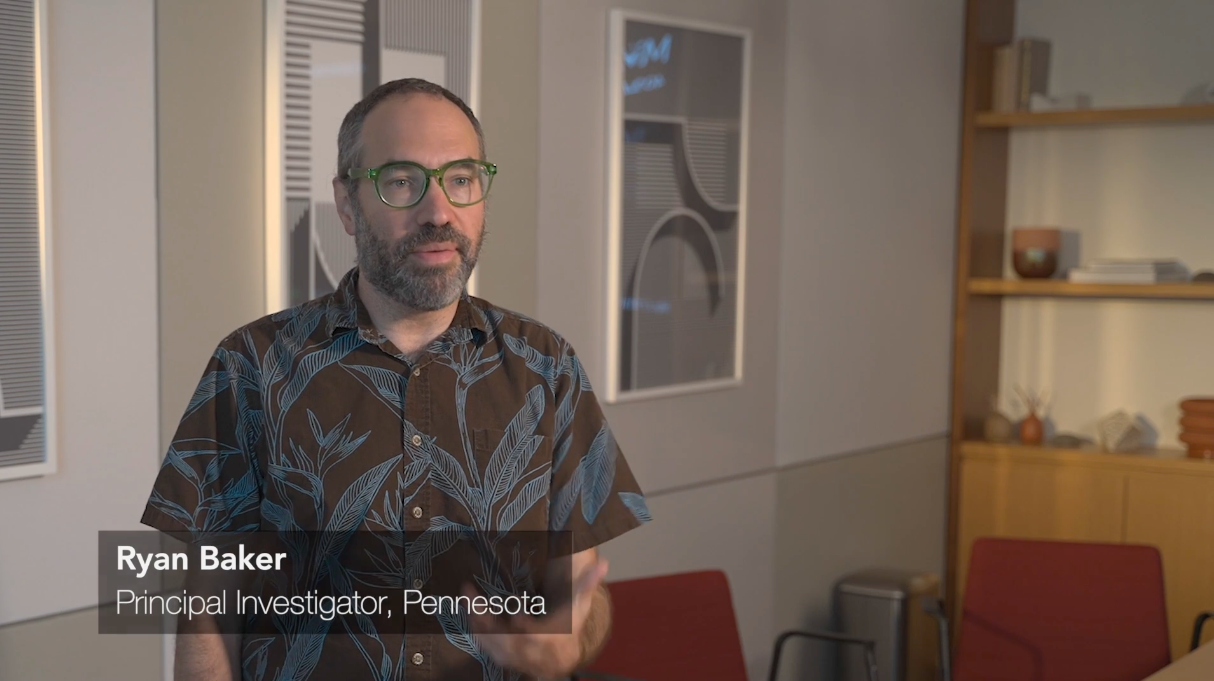
See the Pennesota Project in Action
Research Highlights
Using Machine Learning to Detect SMART Model Cognitive Operations in Mathematical Problem-Solving Process
Toward Asset-Based Instruction and Assessment in Artificial Intelligence in Education
Webcam-based Eye Tracking to Detect Mind Wandering and Comprehension Errors
Acknowledgments
We gratefully acknowledge the leadership of the University of Pennsylvania, in partnership with sub-award recipients at the University of Denver, the University of Minnesota, and the University of New Hampshire, and with collaboration from the University of Adelaide and the University of Houston.
Explore Our R&D Projects
The EF+Math portfolio of R&D projects developed innovative math learning products and advanced research on mathematics learning, executive function skills, and equitable learning experiences using inclusive R&D methods.