




Fraction Ball
Project Overview
Fraction Ball reimagines how students learn math by combining physical movement, basketball-inspired games, and mathematical thinking to make rational number learning engaging for students in grades 4–5. With its focus on embodied play, joy, teamwork, and collaboration, Fraction Ball focuses on developing the whole child—body, mind, and heart—as students work together as members of their classroom community.
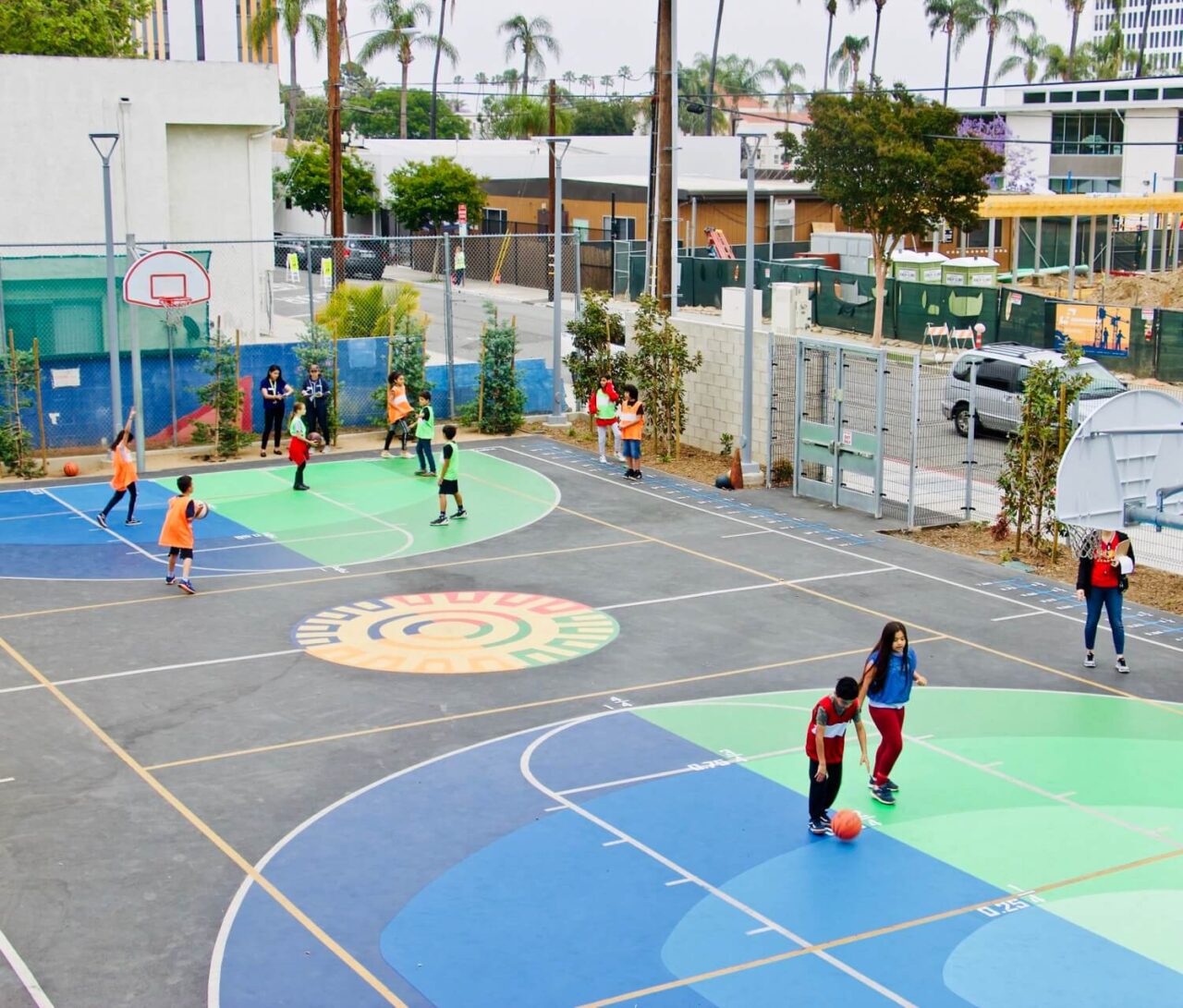
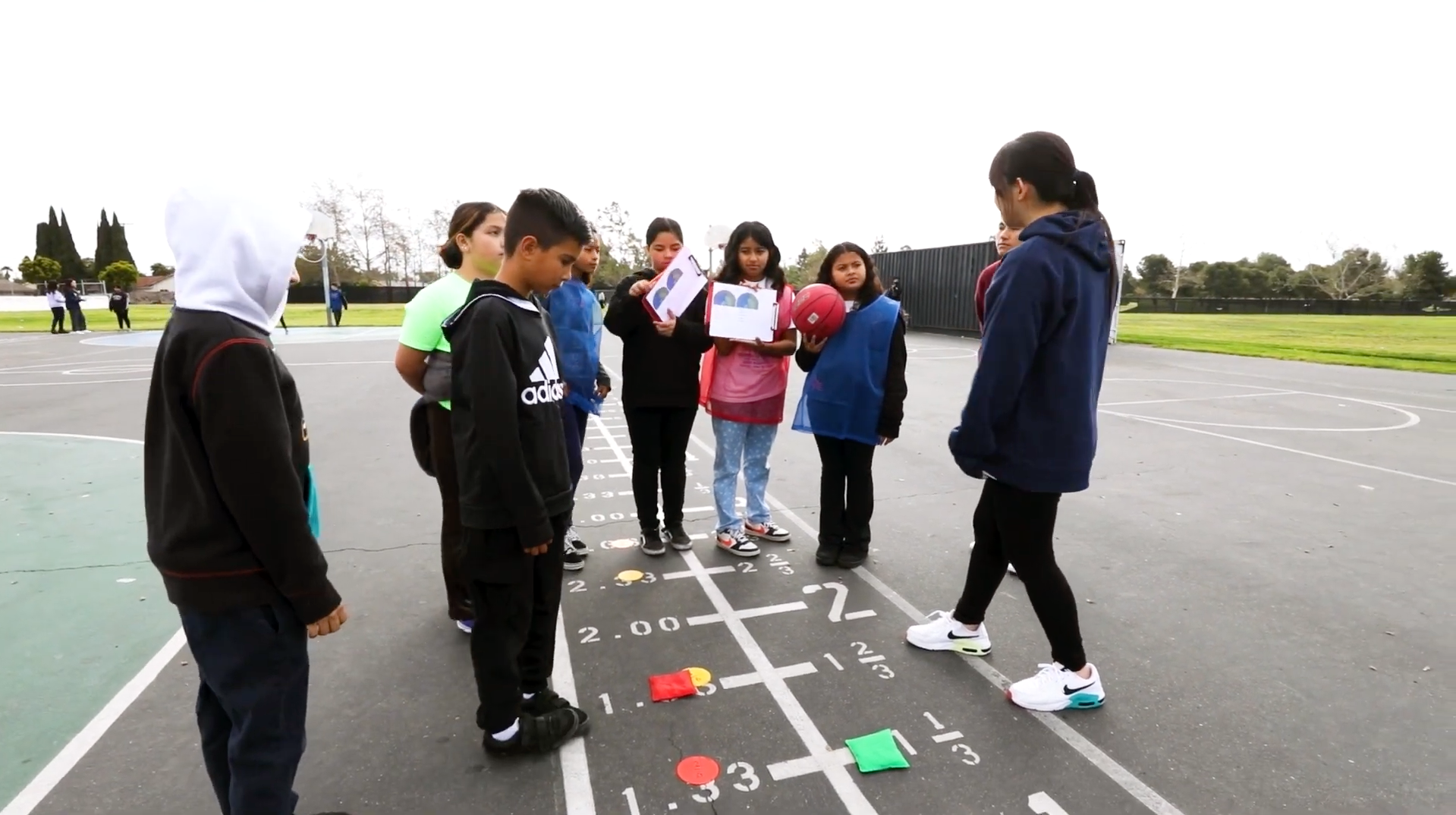
Through a comprehensive 16-lesson unit, students learn critical fraction and decimal concepts, including magnitude comparison, addition, and converting between representations. Fraction Ball includes both classroom lessons and basketball court-based games, co-designed with teachers and students to ensure the activities are engaging and practical for classroom use. The program integrates rational number concepts into games played on colorful courts marked with fraction and decimal arcs, alongside life-sized number lines for scoring. Students play as a team, rotating through different positions to take on roles like shooting the ball, tracking points, and keeping score. This embodied learning approach connects physical movement with mathematical understanding, helping students develop executive function skills (EFs) while tackling one of math education’s most challenging topics.
Project Approach
Fraction Ball’s approach weaves together math, executive function skills, and equity to help students deepen their understanding of rational numbers through outdoor games and classroom activities.

Mathematics
Playful embodied cognition approach to rational number understanding in grades 4–5, including fraction magnitude, equivalence, addition/subtraction, and conversions.

Executive Function Skills
Opportunities to adaptively monitor, plan, update, and shift thinking within reasoning about rational numbers in basketball games and strategies.

Equitable Learning Experiences
Improving math-related emotions and teamwork through collaborative learning. Team roles provide opportunities to participate in a variety of ways, ensuring that all students, including multilingual learners, can be involved.
Project Impact
Fraction Ball has produced measurable impact in classrooms, reaching thousands of students and educators, while contributing research findings to advance math education.

Key Insights and Innovations
Physical movement makes learning fractions collaborative and joyful
Fraction Ball reimagines the schoolyard as a place for learning by overlaying fraction and decimal markings onto an existing basketball court that becomes the basis for Fraction Ball’s court-based games. The traditional 3-point arc becomes 1 point, while smaller arcs represent fractional points. A number line tracks the score, allowing students to visualize magnitude and practice converting between fractions and decimals as they play. This embodied learning approach—where physical movement connects directly to mathematical concepts—decreases math anxiety while building rational number understanding, creating an environment for students where math can be collaborative and joyful.
Fraction Ball leads to positive impacts on fraction learning and contextualized EF skills
Findings from across two independent evaluation studies were consistent in showing that Fraction Ball had statistically significant, positive impacts on measures of fraction learning and contextualized EF skills. Notably, evaluation study findings from 2024-25 showed that students who used Fraction Ball performed significantly better on an overall assessment of fraction learning and improved by more than 12-percentile-points on fractions-to-decimals conversion items, when compared to students who did not use Fraction Ball. Across both studies, students who used Fraction Ball also demonstrated stronger planning skills on a measure of EF skills in a math-based context.
Bottle Cap Bonanza: Student-designed game connects the court to the classroom
Students from an all-female engineering afterschool club in Southern California invented Bottle Cap Bonanza—a tabletop game that teaches fraction concepts through shuffleboard-style play using everyday materials like bottle caps and a poster board. Recognizing the value of this student-created innovation, the Fraction Ball team integrated it as a core component of their classroom activities, illustrating how co-design can elevate student voice and create more effective approaches to math learning.
Fraction Ball empowers teachers to engage in student-centered, collaborative learning
Fraction Ball creates space for interactive, collaborative problem solving where students lead with confidence. When teachers step back and allow students to own the learning on the court—making decisions, collaborating with peers, and discovering mathematical connections—their instructional approach fundamentally shifts. Teachers see new levels of teamwork, sportsmanship, and joy that ripple beyond the court, nourishing academic growth and uniquely human skills. They report that this experience has changed how they think about delivering math instruction in their classroom, inspiring them to bring more student-centered, collaborative practices to other lessons and learning contexts.
Playful assessment captures both math and executive function skills
The Fraction Ball “Exactly” video game offers educators valuable insights into their students’ learning through a validated, playful assessment of planning skills, assessed within the context of fractions. This stealth assessment gathers data useful to researchers and educators, while avoiding testing burden on students or invoking test anxiety.
VOICES FROM THE EF+MATH COMMUNITY
Research Highlights
Incorporating Design Based Implementation Research with a Randomized Controlled Trial
Buckets of Fun: Impacts of Fraction Ball Activities on Students’ Math-Related Emotions
Fraction Ball: Playful and Physically Active Fraction and Decimal Learning
Acknowledgments
Fraction Ball thrives because of the educators, students, administrators, and community partners who bring playful math learning to life. We are especially grateful to the Santa Ana Unified School District, El Rancho Unified School District, Lynwood Unified School District, and El Sol Academy—the community where Fraction Ball first took shape. Their commitment to joyful, equitable math learning continues to guide and inspire the work.
We also gratefully acknowledge the leadership of the University of California, Irvine, in partnership with Juego!.
Explore Our R&D Projects
The EF+Math portfolio of R&D projects developed innovative math learning products and advanced research on mathematics learning, executive function skills, and equitable learning experiences using inclusive R&D methods.